PlanzEvo Biz • November 02, 2026 • 6 min read
Offline POS for Sri Lankan Shops: Keep Selling When the Internet Drops
A till that queues your sales and sends them when the connection returns
It is the busiest hour of the day. A queue has formed at your counter, your phone shows one bar of signal, and the screen on your billing app has begun to spin. A customer sighs. Another glances at the clock. You reach for the calculator and the notebook, as you have done a thousand times, and promise yourself you will enter everything later.
Later is where mistakes live. Sales that are not entered at the time are forgotten, rounded or entered twice. Stock counts drift. By the end of the week, the system and the shelf tell different stories.
Many of us have slow internet some of the time, whether at the market, on the edge of town or during a heavy rain. A till that only works online is a till that fails exactly when you are most busy. This post explains how an offline till works and what you should and should not expect from it.
Why connections drop, and why it is nobody's fault
Mobile data weakens inside concrete buildings. Broadband routers need electricity and power cuts happen. A shop in a busy market can struggle for signal when hundreds of phones compete for the same tower. None of this is unusual, and none of it is something a shop owner can fix.
What you can choose is the tool you rely on. If the tool treats the internet as a requirement, every outage becomes a business problem. If the tool treats the internet as a convenience, an outage becomes a minor event that sorts itself out later.
What an offline till does
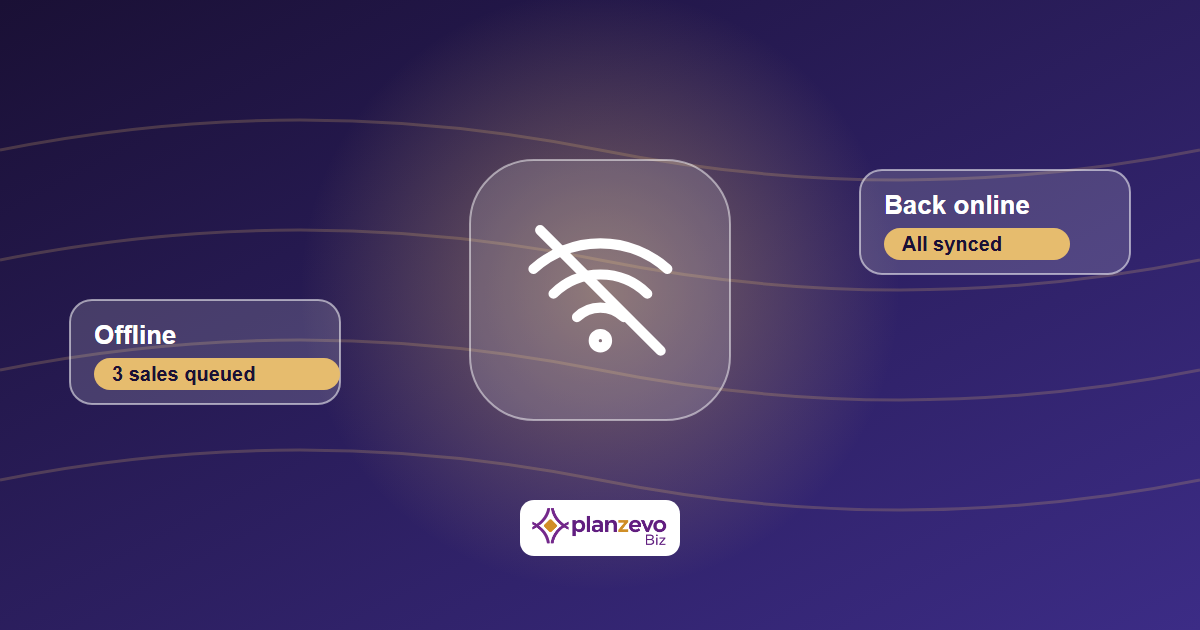
The PlanzEvo Biz till is designed to keep working when the connection is lost. When you ring up a sale without internet, the sale is saved on your device and placed in a queue. The screen tells you that you have no connection but you can still take sales, so you know what is happening and are not left guessing.
When the connection returns, the till replays the queued sales, sending them in the order they were made so that your records catch up. You do not need to re-enter anything, and you do not need to remember which sales were taken during the outage.
For the customer, nothing changes. They pay, they take their goods, and they leave. The technical drama stays behind the counter and mostly never appears.
Protecting against double entries
The worry with any queue is duplication: what if a sale is sent twice? Good systems guard against this. PlanzEvo Biz uses idempotent writes, which in simple terms means that each sale carries a unique reference, and if the same sale arrives twice, it is recognised and counted only once.
You do not need to understand the machinery. The practical result is that a flaky connection that sends, drops and retries will not inflate your sales figures. It is the kind of detail that makes the difference between a till you trust and one you double-check every night.
What offline does not mean
It is only fair to be honest about the limits. An offline till can take sales; it cannot do things that need the internet at that moment. Your device needs to have the app loaded before the connection dropped. Reports that depend on every device's latest sales will be complete only once the queued sales have been sent.
If you are running more than one device at your counter, the totals will catch up as each one reconnects. Do not run your end-of-day Z-report until the queue is empty, otherwise the report will not include everything.
And an offline till does not process payments for you. Cash is cash, and your LankaQR, bank transfer or card payments follow whatever your own provider requires. The till simply records how the customer paid. If a card machine needs a signal to authorise a payment, that part will still need one.
A routine for outages
It helps to have a calm routine ready before the next power cut.
- Keep the app open and loaded at the start of the day, while you have a connection.
- Watch for the no-connection banner. It tells you the till is queuing sales.
- Keep selling normally. Enter items and quantities as usual, including decimal quantities and credit sales.
- When the signal returns, give it a minute. Let the queue clear before you close the day.
- Check the Z-report. Compare it with the cash in the drawer as you normally would.
Staff can follow the same list, which makes it easy to train a new helper in a few minutes.
The notebook as a backup, not a plan
We have a soft spot for the notebook, and it is a fine emergency backup. But as a plan, it asks too much of you at the wrong time. Writing sales by hand under pressure invites missed items and wrong totals, and typing them in afterwards is a second job at the end of an already long day.
With a queueing till, the notebook returns to what it is best at: quick notes, supplier phone numbers and reminders. Your sales, stock and cash live in one place, whether or not the internet was kind that day.
Who benefits most
Any shop with patchy connectivity will notice the difference, but a few kinds benefit especially: market stalls and kiosks, shops in smaller towns, businesses in older buildings with weak signal, and anyone who sells at events or on the road. If your busiest time is also the time when your network struggles, an offline till is not a luxury, it is the thing that keeps the queue moving.
Getting started
Set up your products, open the till on your counter device and try a test sale. Then turn off your data for a minute, ring up another sale, turn the connection back on and watch the queue clear. Seeing it once is the quickest way to trust it.
PlanzEvo Biz starts at LKR 3,000 a month on Starter, with Pro at LKR 5,000 and Premium at LKR 7,500, and annual billing is charged as 10 months. See the pricing page, read about the whole platform, or add your name to the waitlist. When you are ready, create your PlanzEvo Biz account.
Key takeaways
- • Connections drop for reasons no shop owner controls, so a till should not depend on one.
- • An offline till saves sales on your device, queues them and replays them when the connection returns.
- • Unique references mean a resent sale is counted only once.
- • Let the queue clear before running the Z-report, and remember card machines may still need a signal.
- • Keep the notebook for quick notes, not as your outage plan.
Sri Lanka • South Asia • Focus: Colombo, Kandy, Anuradhapura, Batticaloa, Ratnapura