WeddingPlanner • June 11, 2026 • 12 min read
Tamil Wedding Traditions Explained: The Complete Guide
From the Nichayathartham to the Saptapadi, Every Tradition Explained with Care
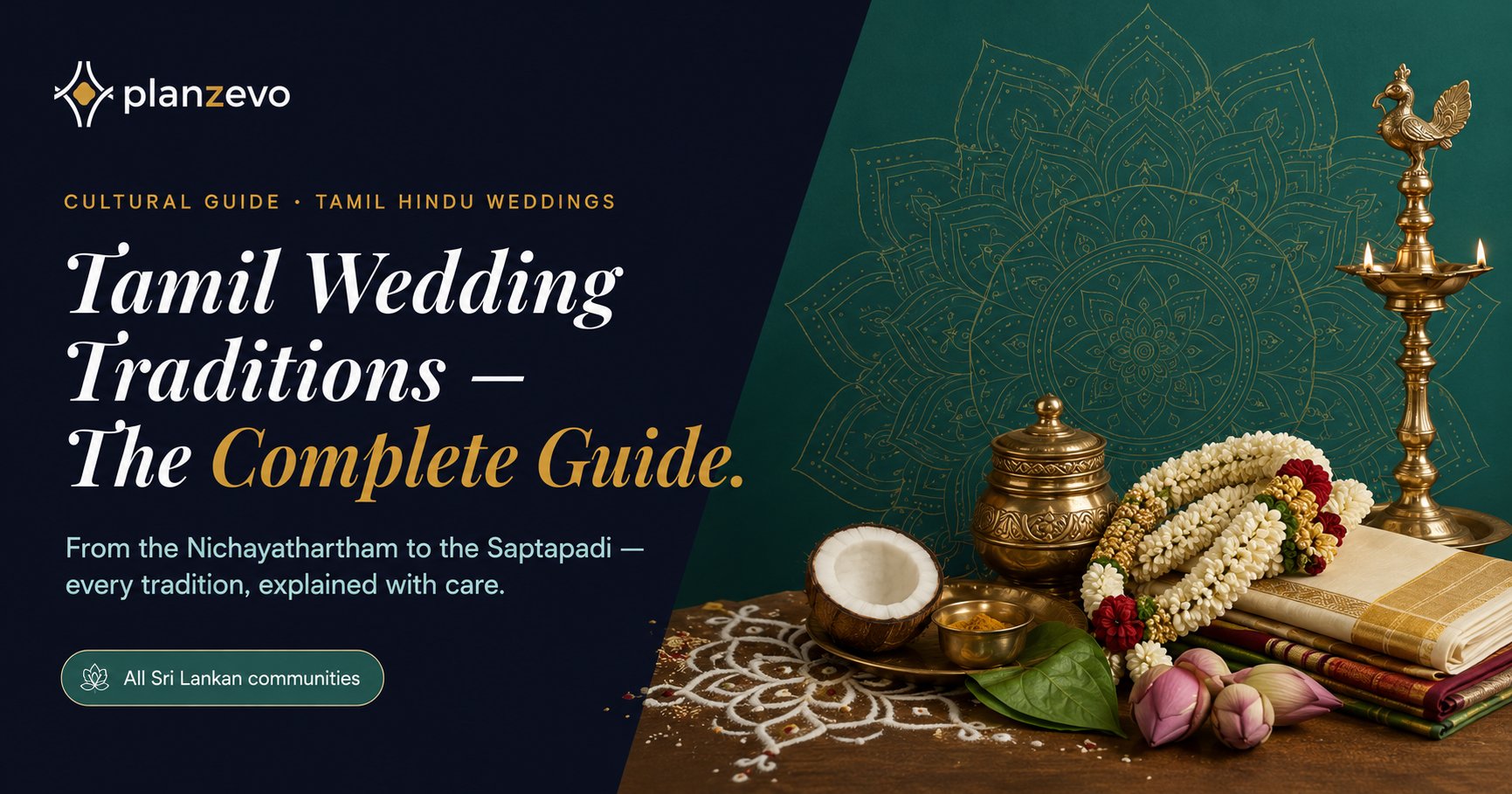
A Tamil Hindu wedding is not a single ceremony. It is a multi-day journey of rituals, music, colour, fire, flowers, and family that unfolds with a logic as ancient as the Vedic tradition itself. Each ritual carries a purpose. Each offering made to the sacred fire, each step around the Agni, each strand of jasmine in the bride's hair, each grain of rice tossed at the auspicious moment, exists within a system of meaning that has been refined over thousands of years. Whether you are a Tamil couple planning your own wedding, a family member seeking to understand the ceremonies your parents and grandparents observed, a diaspora Sri Lankan reconnecting with your heritage, or a guest of another community attending a Tamil Hindu wedding for the first time, this guide is written for you. At PlanZevo, we have had the honour of planning Tamil weddings across Sri Lanka, from Jaffna in the north to Colombo and beyond. We bring to this guide the combined knowledge of cultural experts, experienced officiants, and a deep respect for the living tradition we are describing. Every family observes these rituals with some variation, and regional differences between Jaffna Tamil, Colombo Tamil, and hill country Tamil communities are real and meaningful. What follows is a thorough foundation that will orient you to the tradition as a whole.
The Horoscope Matching and Auspicious Timing
Like all South Asian Hindu wedding traditions, a Tamil wedding begins not with any visible ceremony but with the work of an astrologer. Before any commitment between families is formalised, the horoscopes of the prospective bride and groom are matched by a qualified Jyotish astrologer to assess their compatibility across a range of astrological indicators. This process, known as Jathagam Paaathal in Tamil, examines the positions of the planets at the time of each person's birth and calculates the degree of harmony between the two charts. A strong match is considered essential for a blessed and prosperous union. Once the families are satisfied with the horoscope match, the astrologer also determines the most auspicious date, time, and specific moments for each major ritual across the wedding days. The auspicious moment for the most critical act of the entire wedding, the tying of the Thali, is calculated to the minute. Every subsequent ritual timeline is built around this Muhurtham. In a Tamil Hindu wedding, the Muhurtham is not a guideline but a commitment: the entire logistics of the ceremony, from the positioning of the groom to the chanting of the priest, is orchestrated to ensure the Thali is tied at the precise appointed moment.
The Nichayathartham: The Formal Engagement Ceremony
The Nichayathartham is the formal engagement ceremony that marks the official agreement between the two families to unite their children in marriage. It is a significant social and spiritual event in its own right, separate from the wedding days themselves, and it is observed with considerable ceremony in most Tamil Hindu families. The Nichayathartham typically takes place at the bride's home or a venue chosen by her family. The groom's family arrives bearing gifts including fruit, flowers, betel, sweets, and traditional items, which are presented to the bride's family in decorated trays. A priest conducts prayers and a formal declaration of intent is made before family witnesses. The groom presents the bride with a ring and often with a gold chain and other jewellery as a sign of commitment. The bride similarly presents the groom with a ring. In contemporary practice, the Nichayathartham has taken on an increasingly celebratory character, often accompanied by a family meal, music, and a gathering of extended family that feels as much like a party as a ceremony. The Nichayathartham is important not only as a spiritual formalisation of the match but as the moment when the two families officially begin to know one another, a process that will continue to deepen through the wedding days ahead.
The Mehendi Night: Colour, Music, and Community
The Mehendi ceremony, also widely referred to as the Mehndi night, takes place in the days before the wedding and is one of the most joyful and communal events in the entire Tamil wedding sequence. Women from both families and the close circle of friends gather, typically at the bride's home or a designated venue, for an evening of henna application, music, dance, and celebration. A skilled henna artist applies intricate patterns to the bride's hands and feet, with the designs typically extending up the forearms and sometimes incorporating symbols meaningful to the couple, their initials, or motifs from Tamil culture. In many families it is considered auspicious for the bride's Mehendi to be the darkest and most richly coloured, as the depth of the henna colour is traditionally associated with the depth of love and prosperity in the marriage ahead. Beyond the bride, guests and family members also have their hands decorated, and the evening takes on a festive atmosphere filled with traditional Tamil songs, modern music, dance, and laughter. The Mehendi night is an opportunity for the women of both families to come together informally before the formality of the wedding rituals, and it creates a warmth and familiarity between the two sides of the family that enriches the days that follow.
The Golu and Pre-Wedding Rituals at the Bride's Home
In the days before the wedding, both the bride's and groom's homes undergo a series of preparatory rituals that mark the sacred transition the household is about to experience. These rituals typically begin with a purification of the home, the drawing of Kolam patterns at the entrance of the house using rice flour, which are intricate geometric designs that invite auspiciousness and prosperity. The Golu, an arrangement of figurines and sacred objects on stepped shelving, may be displayed as part of the pre-wedding preparations, particularly in households where this tradition is observed. Perhaps the most significant pre-wedding ritual for the bride is the Turmeric Ceremony, known as the Nalugu or Haldi, where the bride is anointed with a paste of turmeric, sandalwood, and fragrant oils by the women of her family. Turmeric is deeply sacred in Hindu tradition and is considered purifying, beautifying, and protective. The ritual is intimate and joyful, typically accompanied by traditional songs sung by the elder women of the family as they apply the paste to the bride's face, neck, and arms. A parallel version of this ritual is also performed for the groom at his home. These anointing ceremonies represent the formal preparation of the bride and groom for the sacred commitment they are about to make and are understood as a moment of leave-taking from their individual lives before they step into their shared one.
The Kashi Yatra: The Groom's Mock Pilgrimage
The Kashi Yatra is one of the most charming and theatrically joyful rituals in the Tamil Hindu wedding tradition, and it takes place on the morning of the wedding day itself. In the Kashi Yatra, the groom arrives at the wedding venue dressed not as a bridegroom but as a renunciant pilgrim: he carries an umbrella and a palm fan, wears simple clothing, and declares his intention to abandon worldly life and make a pilgrimage to the sacred city of Kashi, the holiest of Hindu cities, in pursuit of spiritual knowledge. At this moment, the bride's father intercepts the groom and makes a heartfelt appeal: he asks the groom to abandon his pilgrimage, to instead marry his daughter, and to take on the responsibilities of the householder's life, promising that the path of marriage and family is itself a path of dharma and fulfilment. The groom, after suitable deliberation, agrees. This ceremony is performed with great warmth and often with considerable humour, as the groom's theatrical reluctance and the father-in-law's earnest entreaties produce much laughter among the gathered family. Beneath the playfulness, the Kashi Yatra carries a profound message: the groom is acknowledging that he is choosing the responsibilities of family life consciously and willingly, not out of obligation but as a deliberate spiritual and moral commitment.
The Mandapam: The Sacred Wedding Pavilion
The physical heart of a Tamil Hindu wedding is the Mandapam, the sacred pavilion constructed specifically for the wedding ceremony. The Mandapam is a covered, decorated structure beneath which the sacred fire, the Agni, is established and within which the central rituals of the wedding take place. The design and decoration of the Mandapam varies considerably between families and venues, but its essential elements are consistent: a raised platform where the couple and priest are seated, the sacred fire pit or Havan Kund at the centre, banana plants or plantain trunks placed at the four corners as symbols of fertility and auspiciousness, mango leaves strung as garlands across the structure, and an abundance of flowers, primarily jasmine and marigold, arranged throughout. The Kolam pattern drawn on the ground beneath the Mandapam is typically the most elaborate of the entire wedding, drawn by skilled women in the family or by a professional Kolam artist. The Mandapam is both a physical space and a sacred container: it demarcates the world of the ceremony from the ordinary world around it and establishes the atmosphere of sanctity within which the Vedic rituals will be conducted by the priest. Setting up the Mandapam correctly, with all its traditional elements in their proper positions, is one of the most important logistical tasks of any Tamil wedding and one that PlanZevo's team approaches with complete cultural attentiveness.
The Maalai Maathal: The Exchange of Garlands
One of the most visually spectacular and emotionally resonant moments of the Tamil Hindu wedding ceremony is the Maalai Maathal, the exchange of garlands between the bride and groom. The garlands used in this ritual are typically made of jasmine and other fragrant white flowers, and they are long, heavy, and beautifully constructed. The exchange is not a solemn, silent ritual. It is a joyful, lively, and often competitive one. As the couple attempts to place the garland around the other's neck, their respective male relatives lift and lower them to make the task more difficult, with each side trying to ensure their person places the garland first. The ceremony becomes a playful contest watched with delight by the entire congregation, and it typically produces peals of laughter and cheering from all sides of the family. Traditionally, the first to successfully place their garland around the other's neck is said to be the one who will be the more dominant partner in the marriage. The Maalai Maathal is performed three times in succession, and by the third exchange the mood is almost universally joyful and celebratory. The garlands exchanged during this ritual are worn by both the bride and groom throughout the remainder of the ceremony and hold deep significance: they represent the couple's acceptance of one another and their willingness to be united.
The Tying of the Thali: The Sacred Central Moment
If there is a single moment that defines a Tamil Hindu wedding above all others, it is the tying of the Thali. The Thali is a sacred gold pendant on a yellow thread or gold chain, and it is the central symbol of a Tamil woman's married status. The tying of the Thali around the bride's neck by the groom, at the precise auspicious Muhurtham moment calculated by the astrologer, is the moment the couple becomes husband and wife. Everything in the wedding ceremony builds toward this moment and everything that follows celebrates it. As the Muhurtham approaches, the atmosphere in the Mandapam becomes charged with anticipation. The priest chants the appropriate Vedic mantras, the family members and guests gather closer, and the Nadaswaram, the traditional Tamil wind instrument whose sacred sound fills every major Hindu ceremony, rises to a crescendo. The groom ties the first knot of the Thali around the bride's neck. His sister or a designated female relative from the groom's side ties the second and third knots, formally bringing the groom's family into the act of acceptance. Flower petals and rice are showered over the couple by guests and family members in a gesture of blessing and celebration. The moment the Thali is tied, the congregation erupts in joy. In contemporary Tamil weddings, this moment is almost always the most intensely photographed and filmed of the entire day, and rightfully so: it is the irreversible, sacred, joyful instant that changes everything.
The Saptapadi: Seven Steps Around the Sacred Fire
The Saptapadi is among the most universally observed rituals in the Hindu wedding tradition, and in a Tamil Hindu wedding it takes its place as one of the most solemn and meaningful of all the ceremonies. Saptapadi means seven steps, and the ritual involves the couple walking together around the sacred Agni fire seven times, with each step corresponding to a specific vow or blessing they make to one another in the presence of the fire as witness. The fire, Agni, is considered the most sacred of all witnesses in Hindu tradition: it is eternal, pure, and present at the most significant thresholds of human life. By walking around the fire together, the couple are making their commitments not merely in front of their families and community but before the cosmos itself. Each of the seven steps carries a distinct meaning, typically encompassing vows of nourishment, strength, prosperity, happiness, family, long life, and friendship. The exact wording of the vows chanted by the priest at each step varies between families and between priests, but the structure of seven steps and their corresponding promises is consistent across the Tamil Hindu tradition. In many contemporary Tamil weddings, the Saptapadi is explained in Tamil or English by the officiant as it unfolds, so that guests and family members who may not understand the Sanskrit mantras can follow the profound meaning of what they are witnessing. This is a practice PlanZevo actively encourages as part of making the ceremony fully meaningful for everyone present.
The Oonjal: The Sacred Swing Ceremony
The Oonjal is one of the most distinctively Tamil of all the wedding rituals, and it is a ceremony of particular tenderness and beauty. The Oonjal is a decorated wooden swing, hung and adorned with flowers, on which the bride and groom are seated together while the women of the family sing traditional Tamil songs of blessing and auspiciousness. The couple are gently swung back and forth while being fed a mixture of milk, banana, and honey by the women attending them, and they in turn feed each other. The swinging is understood as symbolic: life will bring its rhythms of high and low, forward and back, and the couple who sits together on the swing learns from the very beginning that they will move through those rhythms together. The songs sung during the Oonjal are among the oldest in the Tamil wedding repertoire, and in families where they are still sung in full voice by the elder women they create an extraordinarily moving atmosphere, connecting the present celebration to generations of Tamil women who sang the same songs at the same ritual before them. In contemporary Tamil weddings, the Oonjal is frequently one of the most photographed moments of the entire celebration, as the combination of the decorated swing, the flowers, the white and gold silk of the bridal attire, and the intimacy of the moment between the couple makes for extraordinary images.
Bridal Attire and the Significance of Silk
The attire of a Tamil Hindu bride is among the most opulent and symbolically rich in the world, and every element carries specific meaning. The bridal saree is traditionally made of Kanjivaram silk, also known as Kanchipuram silk, woven in the silk weaving capital of Tamil Nadu and prized for its extraordinary weight, lustre, and the intricacy of its gold zari work. The colours of a Tamil bridal saree are typically rich and auspicious: deep red, green, and gold are the most traditional and widely observed choices, though families and regional communities have their own colour preferences and customs. The bride's jewellery is equally significant and forms a codified set: the Maang Tikka worn at the parting of the hair, the Nath or nose ring, the Mango necklace and Temple jewellery at the neck, the Vanki armlet on the upper arm, bangles at the wrist, and the Payal anklets. Each piece of jewellery is associated with specific auspicious meanings and is part of the Solah Shringar, the sixteen adornments of a bride in the Hindu tradition. The bride's hair is dressed with jasmine strings, which carry their own deep symbolism of purity and fragrance in Tamil culture. The groom in a traditional Tamil Hindu wedding wears a dhoti and angavastram in white or off-white with gold borders, often accompanied by a silk shirt. In many contemporary Tamil weddings, particularly in Colombo, grooms wear a combination of traditional and modern attire, with the dhoti worn for the ceremony and a suit worn for the reception.
The Reception and Celebration
Following the completion of the wedding rituals, the Tamil wedding celebration continues into a reception that brings together the full extended community of both families. Tamil Hindu wedding receptions are known for their abundance and warmth: the feast is central, the music is lively, and the gathering of the community around the newly married couple is understood as an act of collective blessing and support. The traditional Tamil wedding feast, served on banana leaves, is one of the great culinary experiences of Sri Lankan culture. An authentic banana leaf meal at a Tamil wedding includes rice, multiple curries, rasam, sambar, curd, papadams, and an array of traditional sweets, all served with the characteristic generosity of Tamil hospitality. Entertainment at a contemporary Tamil wedding reception in Sri Lanka ranges from traditional Bharatanatyam dance performances and Carnatic music to modern DJ sets and live bands playing a mix of Tamil, Sinhala, and English music. The couple's first dance, the cutting of the wedding cake, and speeches from family members are now common elements of the reception in Colombo Tamil weddings in particular. The wedding concludes with the bride departing with the groom's family, a moment that is emotionally significant in every Tamil household. The bride's departure from her family home, even in cases where she has lived independently for some time, carries the weight of cultural transition and is marked with emotion, flowers, and the warmth of two families who have now become one.
Planning Your Tamil Wedding with PlanZevo
A Tamil Hindu wedding is one of the most logistically complex and culturally layered weddings in the world. The multi-day structure, the coordination of priests and Nadaswaram musicians and Kolam artists and traditional vendors, the sourcing of Kanjivaram silk and temple jewellery and fresh jasmine in the quantities required, the management of the Mandapam construction and the sacred fire logistics, the catering of a banana leaf feast for hundreds of guests: every element requires deep local knowledge, established vendor relationships, and genuine cultural respect to execute beautifully. At PlanZevo, our team has planned Tamil Hindu weddings across Sri Lanka with exactly this level of expertise. We work with trusted and experienced priests who can guide the ceremony in full Vedic tradition, Nadaswaram ensembles, Kolam artists, traditional decor specialists, Kanjivaram saree suppliers, and every vendor category a Tamil wedding requires. For diaspora Sri Lankan Tamil couples returning to the island to marry in their heritage tradition, we offer particular support: navigating the planning from abroad, ensuring every traditional element is sourced and coordinated correctly, and making the experience of reconnecting with your cultural roots through marriage as meaningful and smooth as possible. Whether you are planning a full traditional multi-day ceremony in Jaffna, a contemporary Tamil Hindu wedding in Colombo, or an intimate ceremony for close family followed by a reception for a wider gathering, PlanZevo brings both heart and precision to every detail. Reach out to our team at planzevo.com to begin planning your Tamil wedding.
Key takeaways
- • A Tamil Hindu wedding is a multi-day celebration rooted in Vedic tradition, with each ritual carrying specific spiritual, cultural, and symbolic meaning.
- • The Nichayathartham formal engagement ceremony marks the official agreement between families and is an important celebration in its own right before the wedding days begin.
- • The Kashi Yatra, where the groom mock-declares his intention to become a pilgrim, is one of the most joyful and theatrically playful rituals of the Tamil wedding tradition.
- • The Maalai Maathal garland exchange is a competitive, laughter-filled ceremony in which each family tries to lift their person to place the garland first.
- • The tying of the Thali at the precise Muhurtham moment is the central act of the Tamil Hindu wedding ceremony, watched by the entire congregation and celebrated with rice, flower petals, and the sound of Nadaswaram.
- • The Saptapadi, seven steps around the sacred fire, is the couple's vow-making ritual, with each step corresponding to a specific promise they make to one another before Agni as witness.
- • The Oonjal swing ceremony is a distinctly Tamil tradition of tenderness and beauty, accompanied by ancient songs sung by the women of the family.
- • PlanZevo specialises in planning Tamil Hindu weddings across Sri Lanka with full cultural respect, including dedicated support for diaspora couples returning to Sri Lanka to marry.
Sri Lanka • Northern Province • Focus: Jaffna, Colombo, Trincomalee, Batticaloa, Kandy, Vavuniya