WeddingPlanner • June 08, 2026 • 11 min read
Sinhala Wedding Traditions Explained: The Complete Guide
From the Jayamangala Gatha to the Kiri Ithireema, Every Tradition Explained with Respect and Depth
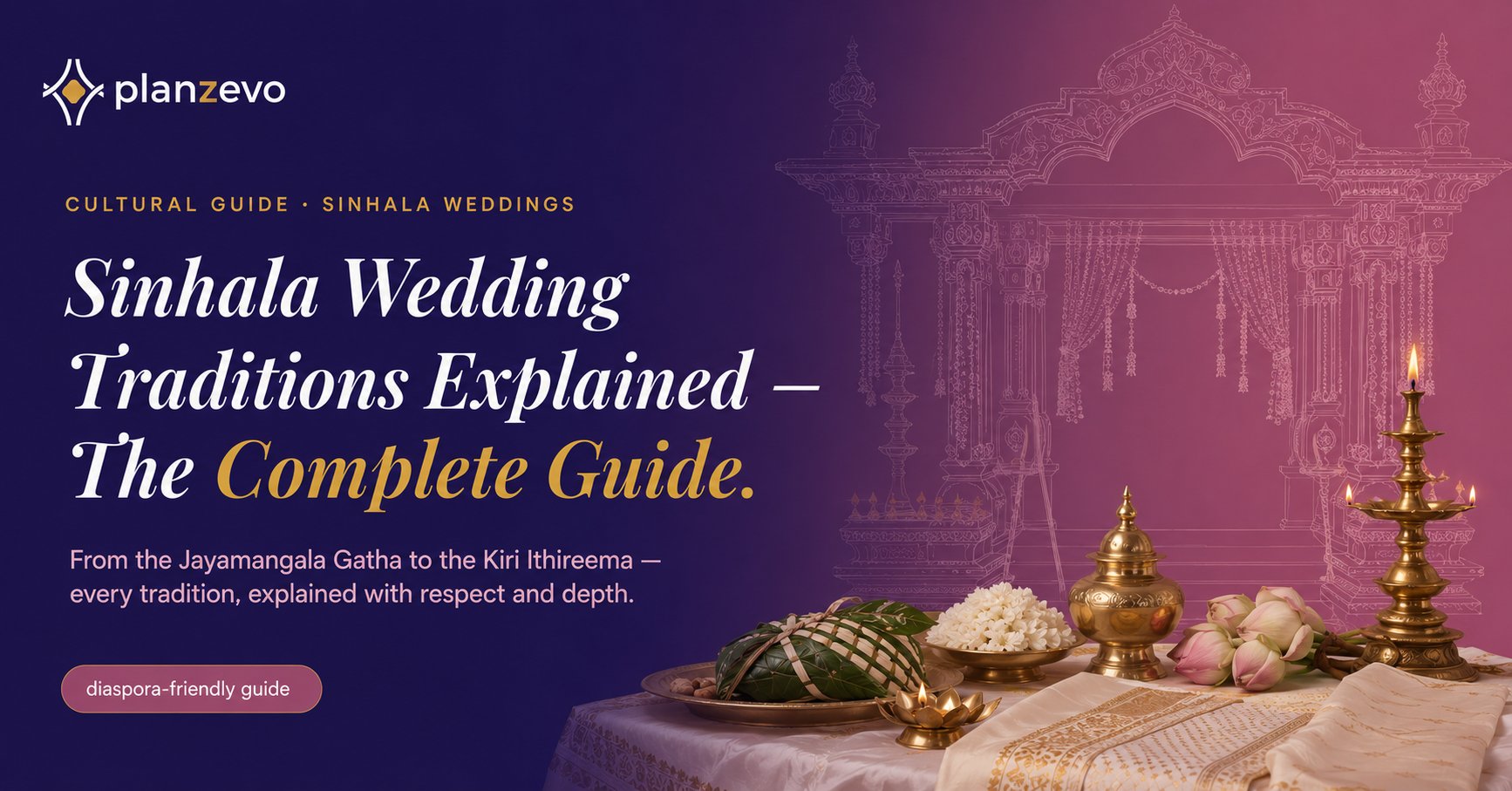
A Sinhala wedding is one of the most layered, symbolically rich, and visually beautiful celebrations in the world. Rooted in centuries of Buddhist tradition, Kandyan royal heritage, and the deep values of Sri Lankan family life, every element of a Sinhala wedding ceremony carries meaning. The brass oil lamps are not decoration they represent the dispelling of darkness. The betel leaves are not a garnish they are a symbol of prosperity and respect. The Jayamangala Gatha are not merely chanted words they are ancient verses of blessing that have opened Sri Lankan weddings for over a thousand years. Whether you are a couple planning your own Sinhala wedding, a diaspora Sri Lankan reconnecting with your roots, or a guest attending a Sinhalese ceremony for the first time, this guide will walk you through every tradition with clarity and depth. At PlanZevo, we have had the privilege of planning and coordinating hundreds of Sinhala weddings across Sri Lanka. We have written this guide to be the most thorough, respectful, and genuinely useful resource available because every couple who chooses this beautiful tradition deserves to understand what they are stepping into.
The Nakath: Why the Auspicious Time is Everything
Before a single flower is arranged or a single invitation is sent, a Sinhala wedding begins with the Nakath. The Nakath refers to the auspicious times and dates selected by a licensed astrologer an Astrologer or Nakkaththa expert based on the horoscopes of both the bride and groom. In Sinhalese tradition, the alignment of planetary positions at the time of key ritual moments is believed to determine the fortune, harmony, and prosperity of the couple's union. The astrologer provides a detailed document specifying the precise auspicious time for the Poruwa ceremony (the central ritual), the time the bride should depart from her home, the time the groom should arrive at the venue, and the exact moment the couple's little fingers should be tied together during the ceremony. Every significant action on the wedding day is timed to a specific Nakath. For many Sri Lankan families, no detail of the wedding day is finalised until the Nakath document is received. Guests are informed of the ceremony start time based on this and unlike western weddings where things often run late, the Poruwa ceremony typically begins with remarkable precision because the auspicious moment cannot be moved. For couples planning a Sinhala wedding, working with a trusted astrologer early in the planning process is essential, as the Nakath affects venue booking, vendor scheduling, and every timeline on the day.
The Homecoming Rituals: Preparing the Bride and Groom
In traditional Sinhala weddings, the days before the ceremony involve specific preparatory rituals that mark the transition of the bride and groom from their single lives to their new shared identity. One of the most significant pre-wedding traditions is the Anointing Ceremony, where the bride and groom are each ritually bathed and anointed with herbal oils, turmeric, and fragrant preparations at their respective family homes. This is typically conducted on the morning of the wedding day or the evening before, accompanied by the chanting of pirith Buddhist protective verses. The ritual cleansing is symbolic: the bride and groom are purified and prepared for the sacred commitment they are about to make. In some families, a Dummala ceremony also takes place, where aromatic resins are burned and the smoke is used to cleanse and bless the bridal attire. While these deeply traditional elements are observed with varying degrees of formality depending on the family, they represent the understanding that a Sinhala wedding is not a single event but a process of transition that begins well before the couple steps onto the Poruwa.
The Poruwa: Heart of the Sinhala Wedding Ceremony
The Poruwa is the ceremonial platform at the heart of every traditional Sinhala wedding, and it is the most visually iconic element of the celebration. The Poruwa is a decorated wooden or bamboo platform, elaborately adorned with white flowers most traditionally jasmine and white orchids betel leaves, coconut fronds, paddy sheaves, and other auspicious items. The platform represents the threshold between two lives becoming one. The design and decoration of the Poruwa is itself an art form. In Kandyan-style weddings, the Poruwa is traditionally rectangular, elevated, and heavily draped with white and gold floral arrangements. In Lowcountry Sinhala weddings, the style may differ slightly in proportion and decoration, but the symbolic elements remain consistent. Positioned on the Poruwa you will find: a brass oil lamp (the Pahana), which is kept burning throughout the ceremony; sheaves of paddy (representing fertility and abundance); a pot of water with a coconut placed on top (symbolising prosperity); betel leaves arranged in specific formations; and traditional offerings including fruits, flowers, and coins. The couple steps onto the Poruwa together at the precise auspicious moment specified by the Nakath, accompanied by the sound of traditional Hewisi music played by a group of drummers and musicians. This moment the couple ascending the Poruwa together for the first time is the emotional centrepiece of the entire celebration.
The Jayamangala Gatha: Ancient Verses of Blessing
Once the couple is seated on the Poruwa, the ceremony begins with the chanting of the Jayamangala Gatha a set of eight sacred Pali verses that invoke the blessings of the Buddha and commemorate eight moments of triumph over adversity in Buddhist teaching. Each verse recounts an occasion when the power of the Dhamma prevailed, and in doing so calls that same auspicious power into the lives of the couple being united. The Jayamangala Gatha have been chanted at Sinhala weddings for well over a thousand years, and their recitation creates an atmosphere of profound sacredness and cultural continuity. They are typically chanted by a group of monks or by a trained officiant, and guests are expected to observe respectful silence during this portion of the ceremony. For diaspora Sri Lankans or guests unfamiliar with Pali, understanding what is being chanted adds an entirely new dimension to the experience. Hearing the verses is moving even without understanding the words understanding their meaning makes it deeply so. After the Jayamangala Gatha, the officiant typically reads a recitation outlining the duties and responsibilities of the husband and wife to one another, drawn from Buddhist teachings on the nature of a harmonious marriage.
The Tying of the Little Fingers: The Binding Ritual
One of the most tender and symbolically powerful moments of the Poruwa ceremony is the tying of the little fingers. At the precise auspicious moment specified in the Nakath document, a length of white thread or a golden cord is wound around the little fingers of the bride and groom, binding them together. This act is the Sinhala equivalent of the exchange of rings in a western ceremony the moment the couple are formally and publicly united. The thread used in this ritual is significant: it has typically been blessed and is wound a specific number of times, representing the intertwining of two lives and the intention to walk forward together. The officiant presiding over the ceremony guides the couple through this ritual, and it is typically accompanied by the continued sound of the Hewisi ensemble. After the fingers are tied, the couple may also exchange rings in a modern adaptation of the ceremony a blend of the traditional Sinhala ritual with a practice now familiar to most Sri Lankan families. It is worth noting that this moment, more than any other in the ceremony, is the one most often captured in photographs. The framing of two pairs of hands, fingers gently bound, against the backdrop of the decorated Poruwa, is one of the most iconic images in Sri Lankan wedding photography.
Pouring of Water and the Role of the Uncle
Following the tying of the fingers, one of the most distinctive traditions of the Sinhala Poruwa ceremony takes place: the pouring of water over the joined hands of the couple by the maternal uncle of the bride. This ritual has deep cultural roots. In traditional Sinhala society, the maternal uncle held a position of particular honour and authority within the family structure he was the guardian, the protector, and in many communities, the person whose blessing was most significant for a marriage. By pouring water over the couple's joined hands, the uncle symbolically blesses and ratifies the union. The water flows over the couple's hands into a vessel below, washing away any obstacles and calling prosperity into the new union. In modern Sinhala weddings, this role is still observed with great reverence. If the maternal uncle is not living or not available, another designated family elder may take on the role but the tradition of having a senior male family member from the bride's maternal side perform this act remains a meaningful and frequently observed part of the ceremony. After the uncle, other senior family members may also perform blessings on the Poruwa, making this section of the ceremony an extended and moving moment of family acknowledgement.
The Kiri Ithireema: The Milk Rice Ritual
The Kiri Ithireema the milk rice feeding ritual is one of the most intimate and widely recognised traditions of the Sinhala wedding ceremony, and it marks a significant turning point in the proceedings. Kiri Bath, the Sri Lankan milk rice, is prepared specifically for the wedding and carries enormous cultural weight. Cooked with rich coconut milk until it is fragrant and firm, it is served on a betel leaf. During the Kiri Ithireema, the bride and groom feed pieces of the milk rice to one another by hand. This act of mutual feeding is a powerful symbolic statement: it represents the commitment to nourish and sustain one another, to share what they have, and to care for each other through all of life's seasons. The feeding is gentle, often tender, and almost always produces a moment of genuine joy between the couple a brief private moment of connection in the middle of a public ceremony. Kiri Bath is also deeply auspicious in Sri Lankan culture. It is the food prepared for the Sinhala and Tamil New Year, for the birth of a child, for the first day of school, and for any momentous new beginning. Its presence at the wedding underscores the understanding that this union is one of life's most significant new beginnings.
The Gift of the Cloth: Naedda and the Exchange of Gifts
The exchange of gifts between the two families is a cherished tradition in Sinhala weddings, formalised in the ritual gifting of cloth and other significant items on the Poruwa. The groom traditionally presents the bride with a length of cloth the Naedda which is a white cloth with a gold border that becomes part of her ceremonial dress. This gift represents the groom's commitment to clothe and provide for his bride. In the full traditional form of the ceremony, the bride's family and the groom's family also exchange gifts publicly, with trays of items presented and acknowledged in front of the gathered guests. These trays may contain fruit, betel, flowers, traditional sweets, gold jewellery, and other auspicious items. The nature and elaborateness of the gift exchange varies considerably between families and between different regions of Sri Lanka. Kandyan weddings, for instance, tend to follow a more formal and codified version of the gift exchange than Lowcountry weddings, reflecting the influence of the royal court traditions of the Kandyan Kingdom on highland Sinhala wedding customs. In contemporary weddings, the gift exchange may be adapted or abbreviated, but the presentation of the Naedda by the groom to the bride remains a touchstone moment in virtually every traditional Sinhala ceremony.
Descending the Poruwa: The Race and the Homam
The conclusion of the Poruwa ceremony involves the couple descending from the platform together, and in many Sinhala wedding traditions this descent includes a delightful ritual: a symbolic race. As the couple steps down from the Poruwa, custom holds that whoever steps off first will be the dominant partner in the household. This moment almost always produces laughter and warmth from the crowd, and in many ceremonies is playfully orchestrated by family members coaching their side. It is one of the moments in a Sinhala wedding that bridges the sacred and the joyful with perfect ease. After descending, the couple may proceed to a Homam a fire ritual performed by a Hindu or Ayurvedic priest in some communities and families, where offerings are made to the sacred fire as a blessing on the marriage. While the Homam is more common in certain traditions and less so in others, it represents the breadth of cultural and religious influences that have shaped Sri Lankan ceremonial life over centuries. Following the descent from the Poruwa and any additional rituals, the couple pays respect to their parents and elders, who in turn bless them with the pouring of water over their hands and by placing white thread bracelets on their wrists. These Pirith Nool bracelets, blessed by monks and worn on the wrist, are a protective symbol and remain on the couple's wrists for an auspicious period after the wedding.
Attire: The Kandyan Osariya and the White Suit
The traditional attire of a Sinhala wedding is as distinctive and beautiful as the ceremony itself. The bride traditionally wears the Kandyan Osariya, a style of draping the saree that is unique to Sri Lanka and is one of the most elegant forms of bridal dress in South Asia. The Kandyan Osariya is draped so that the pleats fall at the front and the cloth creates a full, layered silhouette. It is typically in cream or ivory white with intricate gold embroidery and is worn with an elaborate breast covering called the Hatte, which is richly decorated with traditional patterns. The bridal jewellery set for a Kandyan wedding is equally distinctive and historically codified: the Nadhi Mala necklace, the Petti necklace of gold and precious stones, the Karna Phool earrings, the Sithige or headpiece, bangles, and rings are all part of the traditional jewellery ensemble, and a fully dressed Kandyan bride in complete traditional regalia is an extraordinary sight. The groom in a traditional Kandyan wedding wears a white cloth wrapped in the Kandyan style with a Malalgaha (a decorative sash), an embroidered jacket or white shirt, and a headdress. In Lowcountry Sinhala weddings and in more modern ceremonies, grooms frequently wear a white western-style suit, often with a traditional cloth component incorporated as a sash or wrap. The specific style of attire reflects the couple's regional background, family tradition, and personal aesthetic, and every variation is beautiful in its own right.
After the Ceremony: Reception, Feasting, and the Journey Home
The Poruwa ceremony is the sacred heart of a Sinhala wedding, but what follows is equally important to the fabric of the celebration. The wedding reception in a Sinhala wedding is a generous, joyful gathering where family and friends come together to feast, celebrate, and wish the couple well. The reception meal is a centrepiece of Sri Lankan hospitality: a full rice and curry spread with multiple accompaniments, seafood, meats, vegetarian dishes, sambols, and desserts that reflect the extraordinary depth of Sri Lankan culinary tradition. Speeches, the cutting of the wedding cake, and the couple's first dance are modern additions to many Sinhala receptions, reflecting the blending of western and local traditions that characterises contemporary Sri Lankan weddings. Entertainment ranges from traditional Baila music and dancing, a distinctly Sri Lankan party genre with Portuguese roots, to modern DJ sets and live bands. As the reception concludes, one of the final traditional moments is the departure of the bride from her family home. Whether she is departing symbolically from the reception venue or literally from her family house, this moment carries deep emotional weight. In some traditions, the bride's mother places her daughter's hand into the groom's hand as a formal handing over of care and protection. It is among the most moving moments of any Sinhala wedding, and one that experienced wedding photographers know to watch for.
Planning a Sinhala Wedding with PlanZevo
A Sinhala wedding is not simply an event to be organised. It is a living cultural ceremony with layers of meaning that deserve to be handled with both logistical excellence and genuine cultural respect. At PlanZevo, our team includes specialists who have grown up within this tradition, planned dozens of Sinhala weddings across Sri Lanka, and understand both the sacred protocols and the practical complexities that come with coordinating every ritual correctly. We work with trusted astrologers for Nakath selection, experienced Poruwa decorators who understand the traditional design vocabulary, licensed officiants, Hewisi ensembles, and every vendor category a Sinhala wedding requires. For diaspora couples returning to Sri Lanka to marry in the tradition of their heritage, we offer particular expertise: navigating the unfamiliar logistics of planning from abroad, sourcing traditional elements that may not be easy to find outside the island, and ensuring that the ceremony reflects your roots with authenticity and pride. Whether you are planning a traditional ceremony in all its full ceremonial glory, a contemporary Sinhala wedding that blends tradition with modern style, or an intimate Poruwa ceremony followed by a small gathering of loved ones, PlanZevo is the partner that brings both heart and precision to every detail. Reach out to our team at planzevo.com to begin planning your Sinhala wedding.
Key takeaways
- • The Nakath auspicious time, selected by an astrologer based on the couple's horoscopes, governs the precise timing of every key ritual in a Sinhala wedding.
- • The Poruwa is the sacred ceremonial platform at the heart of the Sinhala wedding, decorated with jasmine, betel, paddy, and brass lamps, each carrying deep symbolic meaning.
- • The Jayamangala Gatha are ancient Pali verses chanted at the ceremony, invoking the blessings of the Buddha through eight stories of triumph recorded in Buddhist teaching.
- • The tying of the little fingers at the auspicious Nakath moment is the formal act of union, equivalent to the exchange of rings in a western ceremony.
- • The Kiri Ithireema, where the couple feed each other milk rice by hand, is among the most intimate and symbolically rich rituals of the Sinhala wedding tradition.
- • The Kandyan Osariya is the iconic bridal dress of a Sinhala wedding, worn with a historically codified set of gold and gemstone jewellery unique to Sri Lankan tradition.
- • Sinhala weddings beautifully blend Buddhist spiritual tradition, Kandyan royal heritage, and warm Sri Lankan family values into a single, deeply meaningful celebration.
- • PlanZevo specialises in planning Sinhala weddings with full cultural respect and logistical precision, including support for diaspora couples returning to Sri Lanka to marry.
Sri Lanka • Western Province • Focus: Colombo, Kandy, Galle, Nuwara Eliya, Negombo