WeddingPlanner • June 07, 2026 • 8 min read
Kandyan Wedding Ceremony — Traditions and Meaning
A complete guide to decoding traditional Sri Lankan customs, Poruwa rituals, and the deep symbolic heritage of Upcountry weddings.
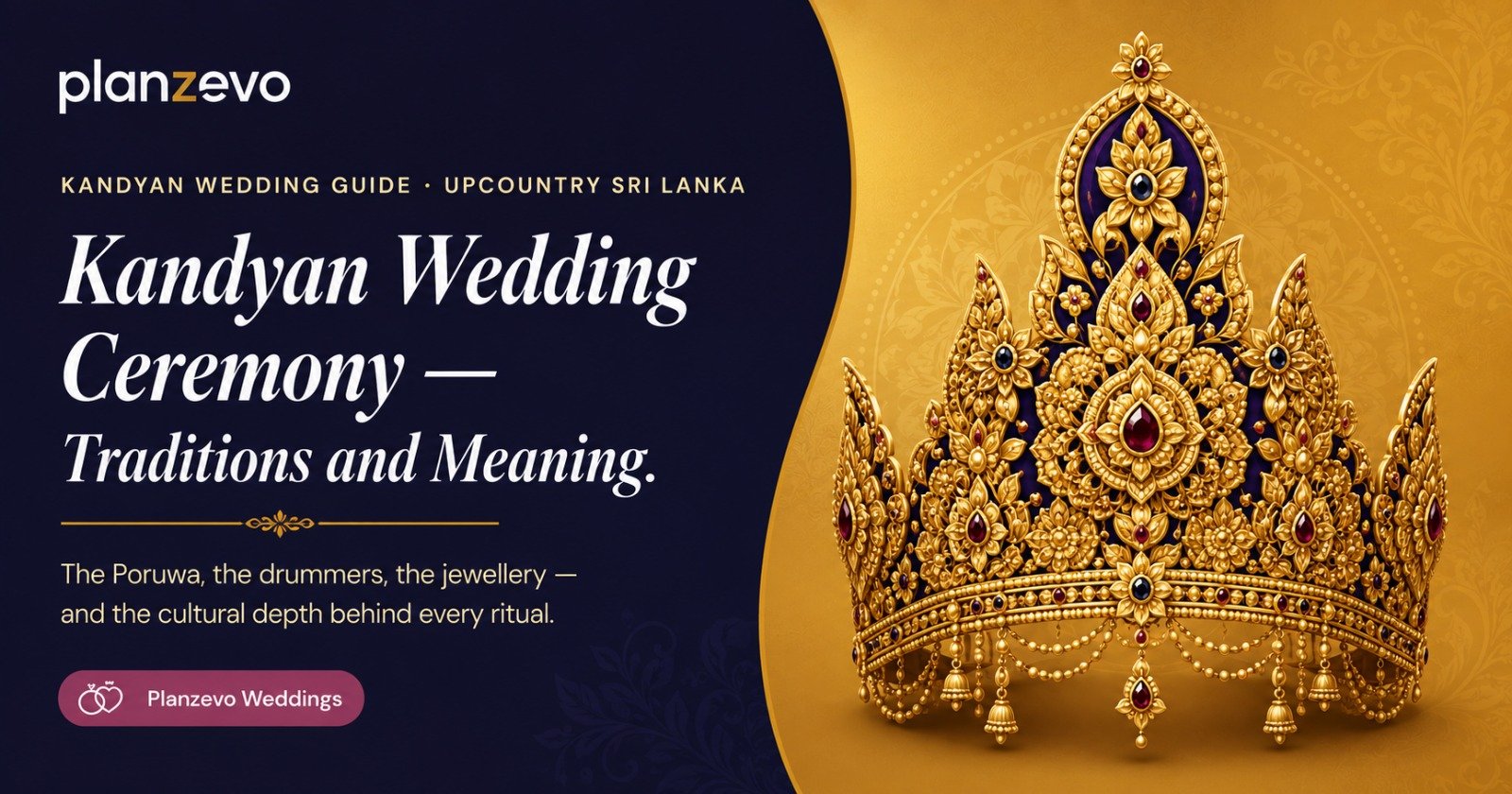
There are weddings that are beautiful. And then there are weddings that are alive, pulsing with drumbeats, wrapped in gold, and rooted in a heritage that predates modern Sri Lanka by centuries.
A Kandyan wedding is the latter.
Originating from the royal court traditions of the Kandyan Kingdom in upcountry Sri Lanka, this ceremony is one of the most visually magnificent and spiritually layered celebrations in all of South Asia. Every ritual has a reason. Every ornament carries meaning. Every moment has been refined across generations.
Here is everything behind it, explained with the depth it deserves.
Kandyan vs. Low Country — Understanding the Difference
Not all Sinhala weddings are the same. Upcountry Kandyan weddings are strongly rooted in traditional Sinhalese values, while low country Pahatharata weddings tend to blend Sinhala customs with a more Western influence, particularly in attire.
The Kandyan ceremony is the more ritually intact of the two. Every detail, from the Poruwa ceremony to the drummers and traditional attire, carries symbolic meaning. It is not simply a wedding format. It is a living expression of Sri Lankan identity, and it demands to be understood as such.
Before Anything Begins — The Nekatha
The astrologer determines the date for the wedding and the auspicious times for each ritual after examining the horoscopes of both the bride and groom. Every arrangement is then planned around those timings, with the strong belief that doing so brings goodness to the couple.
Families believe these astrological timings bring prosperity, harmony, and longevity to the couple's life together. The months of March, May, June, and July are often seen as peak wedding seasons among the Sinhalese, though the most auspicious date always depends on the individual horoscopes of the bride and groom.
This isn't ritual for ritual's sake. It's the belief that a life well begun is already half well lived.
What to plan: Lock in your astrologer before your venue, your caterer, or any other vendor. The Nekatha is the anchor around which everything else is arranged.
The Grand Entrance — Magul Bera Drums and Conch Shells
A Kandyan wedding doesn't begin quietly.
The bride and groom are escorted separately to the Poruwa with the sound of traditional Magul Bera drums and conch shells, believed to ward off evil spirits and announce the auspiciousness of the occasion. The drumming is not background music; it is a ceremonial declaration. It signals to every guest, and to the universe, that something sacred is beginning.
The groom is escorted to the wedding location with a group of drummers and traditional Kandyan dancers. The dancers, in their full costume of white and gold, move in the precise choreography of the Kandyan dance form, one of Sri Lanka's most treasured performing arts.
What to plan: Coordinate drummer and dancer arrival well ahead of the auspicious time. Their entry is timed, it cannot be rushed or delayed.
The Poruwa — Where the Union Is Sealed
The Poruwa ceremony was the only recognised wedlock arrangement in Sri Lanka before registered marriages became a thing in the 1870s. It remains the most necessary and sacred part of a Sinhala wedding.
The Poruwa itself is a beautifully decorated wooden platform, adorned with carvings, floral arrangements, and traditional motifs, that represents the home the couple will build together. The bride and groom ascend the platform simultaneously, stepping on with their right foot first, a gesture symbolising auspicious beginnings.
Chants, offerings, and symbolic gestures like the tying of fingers with a golden thread take place on the Poruwa, blessing the union with longevity and harmony.
The couple then offers betel leaves to elders, receives blessings, and partakes in symbolic acts, including the breaking of a coconut and the pouring of water to signify unity and prosperity.
Sri Lankan weddings involve many people: the master of ceremony, the narrator who recites religious chants, and the four young girls known as the Jayamangala Gatha, who bless the marriage with sacred verse.
What to plan: Ensure the Poruwa is fully decorated and blessed before the couple is seated. Brief your master of ceremonies on timing, each ritual within the Poruwa ceremony has its own auspicious moment.
The Exchange of Seven Betel Leaves
The ceremony often begins with the auspicious seven betel leaves ritual. The bride and groom each take a betel leaf at a time and drop it into the Poruwa, taking turns and repeating the process.
This exchange of seven betel leaves is a uniquely Sri Lankan tradition symbolising mutual respect and acceptance between the couple. It was one of the quieter moments of the ceremony, deliberate, facing each other, and observed in near silence by everyone present.
The Gold Thread — Tying the Fingers
Among the most intimate moments of the Poruwa ceremony is the tying of the little fingers.
The couple's little fingers are tied together with a gold thread while water is poured, a ritual signifying that their lives are now bound, flowing in the same direction. It's a small gesture with enormous weight. Two separate lives, literally connected.
What to plan: Have the gold thread and the water vessel prepared as part of the Poruwa tray. This moment photographs beautifully; position your photographer for a close, intimate shot.
The Muwa Dahanaya — Honouring the Parents
The couple offers betel leaves to their parents as a symbol of respect and gratitude for their love, support, and blessings. This ritual, known as Muwa Dahanaya, signifies the couple's acknowledgement of their parents' role in their lives.
It is a moment that shifts the energy of the ceremony completely. What was focused on the couple turns outward, to the families who shaped them, supported them, and brought them to this day.
In a culture where family is foundational, this ritual carries some of the most genuine emotion of the entire wedding.
The Nalalpata — The Bride's Crown
No element of a Kandyan wedding commands attention quite like the bridal crown.
The Kandyan bride is distinctive from all others; only she has the privilege of wearing the Nalalpata on her wedding day. This ornate forehead ornament is one of the most recognisable symbols of Kandyan bridal identity.
The complete Kandyan bridal jewellery set includes the Nalalpata, Jhumki earrings, multiple necklaces, bangles, and waist chains. Traditional sets contain up to 26 individual pieces. Each piece is chosen with intention. Together, they transform the bride into something that looks less like a guest at a wedding and more like royalty at a coronation.
The Kandyan bride in her traditional Osariya and complementing regalia looks like a queen, and she is the cynosure of all during the ceremony.
What to plan: Jewellery preparation takes time. Build a dedicated window into the morning schedule for the bride's full dressing and jewellery fitting; rushing this moment is never worth it.
The Osariya — The Kandyan Bridal Saree
The Sri Lankan bride, adorned in a traditional Kandyan saree, steps onto the Poruwa with poise, accompanied by her groom in his regal Nilame costume.
The Kandyan saree is draped uniquely, often in ivory or gold, with intricate hand-embroidered detailing and shimmering accessories. It takes its inspiration from the royal court of Kandy.
The groom's Nilame costume, a formal jacket, sarong, and headdress, is equally regal. Together, the couple does not simply appear dressed for a wedding. They appear dressed for a historical moment.
The Reception — Kandyan Dancers, Fire, and Celebration
Once the ceremony concludes, the celebration begins in full colour.
The reception often features Kandyan dancers, fire acts, and traditional drummers, creating a festive and unforgettable atmosphere. The dancers, who performed during the entrance, return for the reception in an expanded performance, a gift to the guests and a continuation of the cultural richness that defines the day.
Traditional music and dance performances are a defining feature of Sri Lankan weddings. The Jayamangala Gatha is sung to bless the couple, while Kandyan dance performances entertain and honour the guests.
The food is equally rooted in tradition. Sri Lankan rice and curry, traditional sweets like Kavum, Kokis, and Athirasa, and the unmistakable warmth of a celebration cooked with intention rather than convenience.
The Modern Kandyan Wedding
While many couples still opt for fully traditional ceremonies, it's becoming increasingly common to blend customs with modern styles. Some hold a civil ceremony followed by a Poruwa ritual. Others choose Western gowns alongside traditional attire or incorporate cross-cultural elements in multicultural unions.
But even in the most modern iterations, the soul remains. A Kandyan wedding is a powerful expression of Sri Lankan identity, and even couples who adapt the format find that the rituals they choose to keep carry more meaning precisely because they were chosen intentionally.
How Planzevo Supports the Full Kandyan Wedding Journey
A Kandyan wedding is one of the most logistically intricate and culturally specific celebrations to coordinate. The Nekatha drives your entire timeline. The Poruwa master, the drummers, the Kandyan dancers, the jewellery artisan, the Osariya draper, and the traditional caterer, every vendor plays a role that is both practically and culturally significant.
Planzevo connects couples planning Kandyan weddings with vendors who genuinely understand the ceremony, not just vendors who list "traditional weddings" as a service category. When you share your brief on the platform, you are matched with Poruwa specialists, experienced Kandyan dance troupes, jewellers familiar with the full 26-piece bridal set, and photographers who know exactly when to be ready for the gold thread, the Nalalpata, and the moment the milk rises.
Every proposal, quote, payment checkpoint, and timeline milestone lives in one shared workspace. No details lost in messages. No miscommunication on auspicious timing. No last-minute surprises on the most important day of your life.
And after the celebration, every vendor review builds a record that helps the next couple planning their Kandyan wedding make faster, better, more confident decisions.
Because a ceremony this ancient and this meaningful deserves a platform built to honour every detail of it.
Key takeaways
- • The Poruwa Rituals: Understanding the steps, symbolic meanings, and cultural significance of the marriage platform customs. Traditional Music and Performance: The vital role of traditional Upcountry drummers (Magul Bera) and dancers in blessing the union. Sacred Bridal Attire: Decoding the heritage and meaning behind the intricate Kandyan bridal jewelry and the traditional golden crown (Nalalpata). Cultural Depth: Exploring the profound historical symbolism beneath every ritual performed during a traditional Upcountry wedding ceremony.
Sri Lanka • South Asia • Focus: Kandy