WeddingPlanner • May 09, 2026 • 6 min read
Why Most Events Go Wrong Before They Even Begin and How a Proper Brief Fixes It
The Silent Planning Mistake That's Costing You Time, Money, and the Event You Actually Imagined
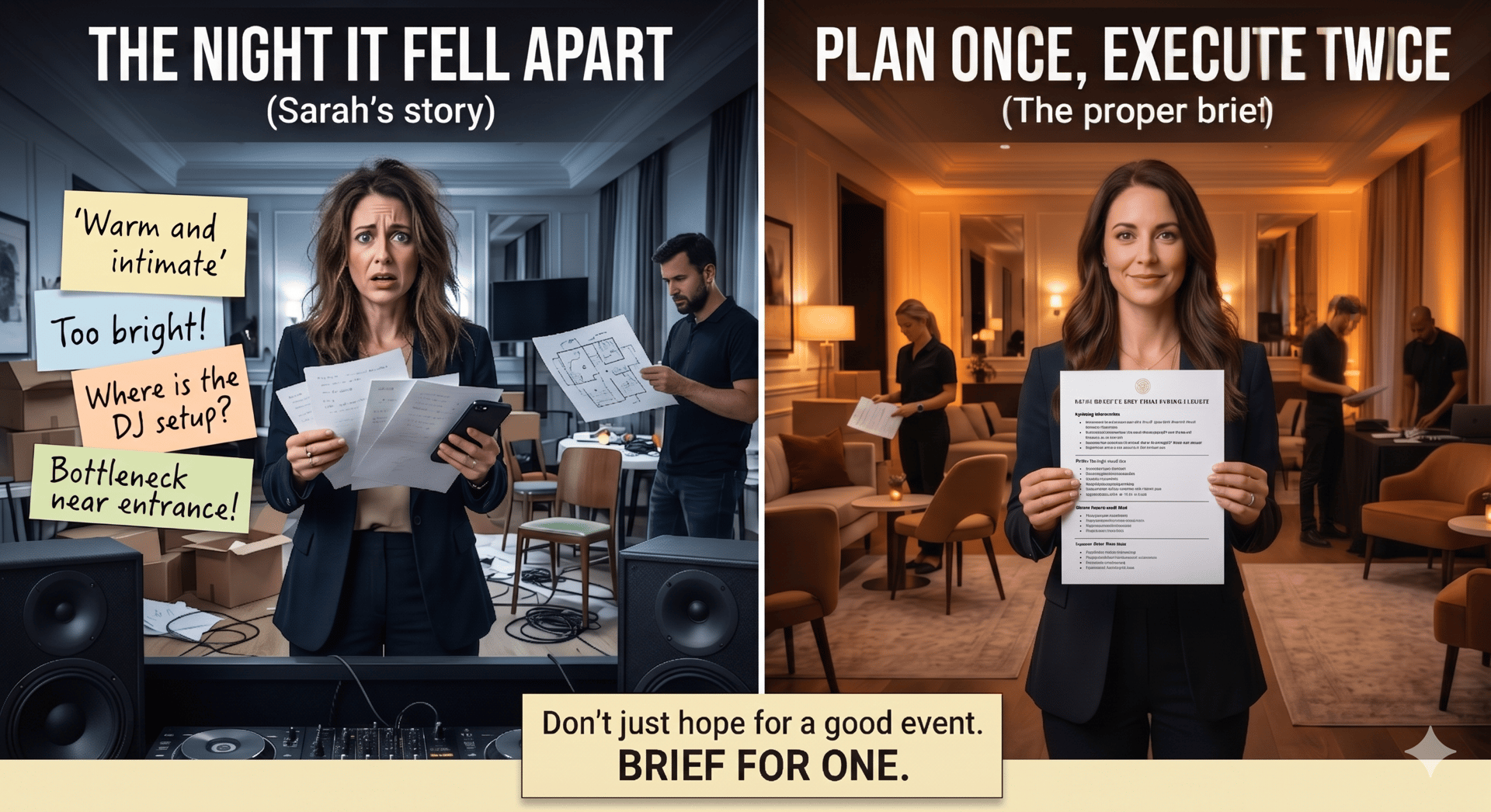
We’ve all seen it: the event that looked great on paper but felt "off" in person. The lighting is too harsh for a "cosy" vibe, the venue layout creates bottlenecks, or the music is so loud that networking becomes a shouting match.
Most people blame "bad luck" or "day-of" mistakes. In reality, most events fail before they even begin because the foundation, the "brief", was cracked.
The Night Sarah's "Perfect" Event Fell Apart
Sarah had been planning the product launch for six months. The venue was booked, the caterer was confirmed, and she had a playlist she just knew would set the right tone. On paper, everything was perfect.
Then the guests arrived.
The lighting, which she'd described to the venue coordinator as "warm and intimate," intimate",bathed the room in a cold, clinical white. The DJ’s idea of "background music" was thumping at 90 decibels. And the cocktail tables? They were clustered so tightly near the entrance that guests formed an awkward bottleneck before they’d even grabbed a drink.
By 8 PM, Sarah was firefighting. By 10 PM, she was exhausted. By the next morning, she was asking the question every host eventually asks: Where did it go wrong?
The answer wasn't the DJ, the venue, or even bad luck. It was Step One.
The Hidden Gap: Intent vs. Interpretation
The biggest hurdle in event planning isn't a lack of effort; it’s a lack of clarity. This is the intent vs. interpretation gap.
When Sarah told a vendor she wanted a "modern, edgy vibe", she was thinking of an industrial warehouse with neon accents. The vendor, however, envisioned a sleek, white-walled gallery with minimal decor. Without a structured brief, you are relying on mind-reading.
This leads to:
Mismatched Expectations: Vendors deliver their version of your vision, not yours.
Budget Creep: Last-minute "fixes" for overlooked details are always more expensive than planning for them from the start.
Wasted Time: Endless back-and-forth emails trying to clarify simple points like seating requirements or guest counts.
Sarah's launch wasn't derailed by bad vendors; it was derailed by a conversation that never truly happened.
The Power of the "North Star" Brief
Imagine if Sarah had handed every vendor a single document before a single contract was signed. Not a mood board, but a brief, specific, structured, and impossible-to-misread.
According to the customer-to-vendor business flow, the first step to successful execution is when the customer shares an event brief. This acts as the "North Star" for every person involved. A high-quality brief converts a vague feeling into a blueprint by explicitly covering:
The Core Basics: Event type, date, city, and guest count.
The Constraints: A crystal-clear budget and timeline.
The Physicality: Seating and space requirements (e.g., "Clear 6-foot walkways between table clusters") to ensure the "flow" matches the goal.
How Technology Bridges the Gap
Even with a good brief, things can get lost if they are scattered across PDFs. Modern event execution relies on a shared execution workspace. When both the host and the vendor manage the same "source of truth", the brief remains alive and accurate.
By using a structured platform, you enable:
Precision Matching: AI can rank vendors based on how well they fit your specific brief and budget.
Proactive Problem Solving: Vendors can view your time plan and suggest improvements, such as setup timing, to prevent bottlenecks before they happen.
Real-Time Coordination: On the big day, teams are synchronized because everyone is following the same blueprint.
The Verdict: Plan Once, Execute Twice
Sarah relaunched her product three months later. This time, she led with a brief. Same venue, same DJ, same caterer, but a completely different event. The room felt exactly the way she’d imagined it, because for the first time, she’d actually told people what that looked like.
If you want to move from "hosting an event" to "building a community", you cannot afford to leave the details to chance. The secret to a flawless event isn't just a great host; it's a great brief.
Don't just hope for a good event. Brief for one.
How detailed is your current event briefing process? Do you find yourself repeating the same instructions to different vendors?
Key takeaways
- • Most events fail at the planning stage, not on the day, the root cause is almost always a weak or missing brief, not vendor error or bad luck.
Sri Lanka • South Asia • Focus: Colombo, Negombo, Galle, Kandy