WeddingPlanner • June 10, 2026 • 10 min read
Wedding Planning Checklist — Your 12-Month Timeline
A step-by-step roadmap to budget, book vendors, and manage your wedding timeline without the stress.
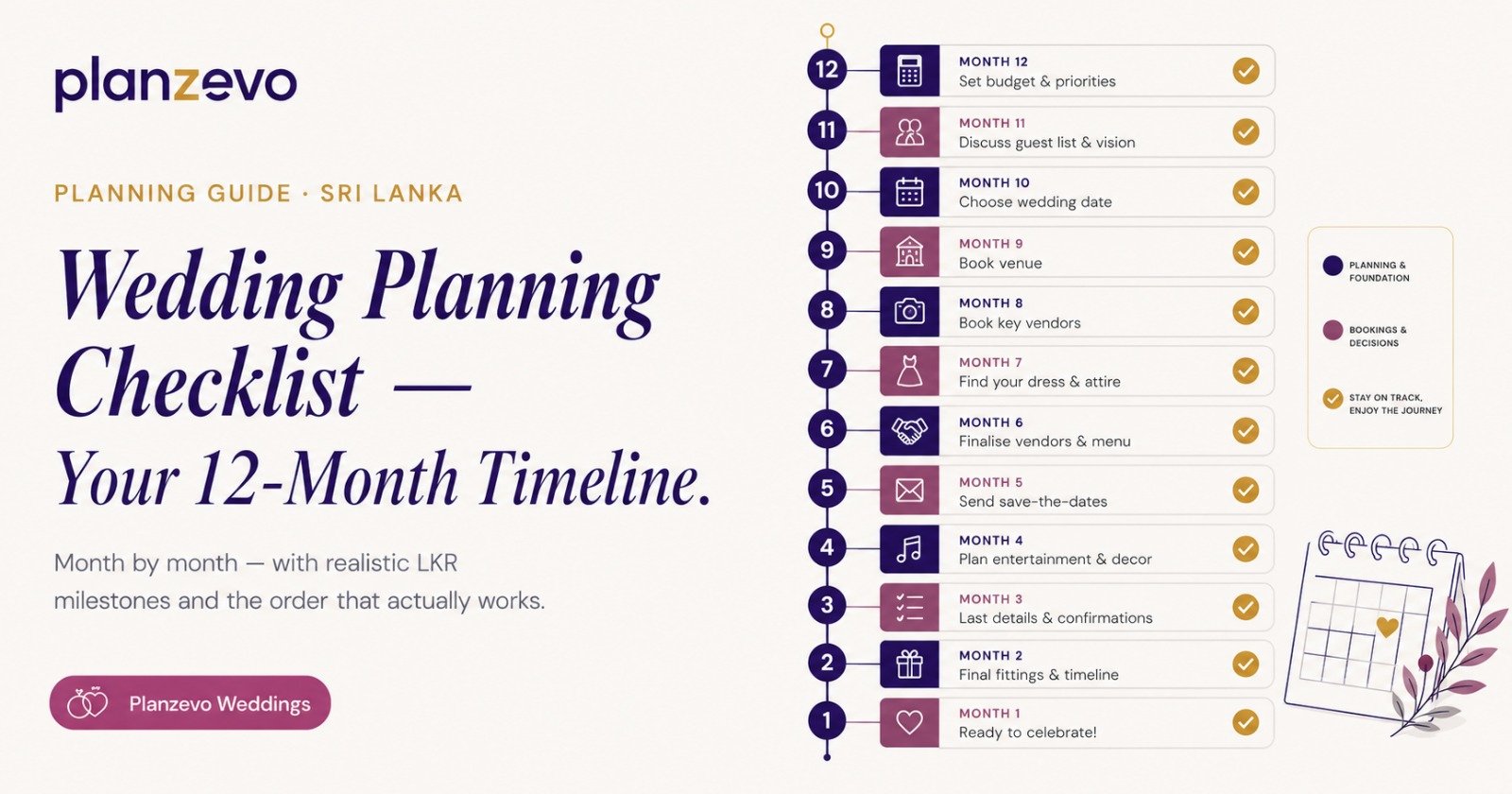
Planning a wedding in Sri Lanka is one of the most rewarding, and most overwhelming, experiences a couple will ever go through. There are hundreds of decisions to make, dozens of vendors to coordinate, and a cultural calendar that demands everything happen in a very specific order.
The couples who get it right don't work harder. They plan smarter, and they start earlier than they think they need to.
This is your month-by-month guide. Realistic milestones, the right order, and no steps skipped.
Why 12 Months?
To secure a specific weekend in peak season, particularly November through April, venues recommend confirming your booking by mid-year at the latest. The best venues in Colombo, Galle, Kandy, and Bentota fill their calendars fast. If you wait until six months out, your first, second, and third choices may already be gone.
Twelve months gives you breathing room to make good decisions, not desperate ones.
Month 12 — Set Your Budget & Priorities
Everything starts here. Before you look at a single venue or contact a single vendor, you need a number, and you need to agree on what matters most.
Quality catering in Colombo alone ranges from LKR 3,500 to 8,000 per person. Multiply that by your expected guest count and you'll quickly understand why budget clarity has to come before everything else.
Sit down together and answer three questions. What is the total amount we are comfortable spending? Who is contributing and how much? And if we have to prioritise, what are the non-negotiables, the venue, the food, the photography, and the attire versus what we are willing to scale back on?
Write it down. Agree on it. Then plan from that number, not toward it.
Key action: Set your total budget. Allocate roughly 30–40% to catering, 15–20% to the venue, 10–15% to photography, and the remainder across décor, attire, entertainment, and miscellaneous.
Month 11 — Discuss Guest List & Vision
Your guest count is not just a social decision. It is a financial and logistical one that determines which venues are viable, what your catering cost will be, and how your entire day is structured.
Sri Lankan weddings traditionally include extended family and community members, creating larger, more fluid guest lists than Western-style celebrations. Be honest with yourselves about the real number, not the optimistic one.
Alongside the guest list, define your vision. What does this wedding feel like? Traditional Kandyan? Contemporary with cultural elements? Destination-style beach celebration? The clearer your vision at this stage, the faster and more confidently every decision that follows will come.
Key action: Lock a firm guest count range, a minimum and a maximum. Brief both families early to avoid last-minute additions that blow your budget.
Month 10 — Choose Your Wedding Date
Your date determines everything, your venue options, your vendor availability, your catering costs, and whether your out-of-town guests can actually attend.
Sri Lanka has two monsoon seasons, so timing your wedding correctly is important. The west and south coasts, Galle, Bentota, and Colombo, are best from November to April. Upcountry Kandy has its own seasonal window. Know your location before you commit to a date.
If your budget is a priority, consider the shoulder months around the peak season. Vendor availability is better, negotiation room is wider, and you'll often get more personalised attention from everyone involved.
Key action: Cross-check your date against the Nekatha if you're planning a traditional ceremony, the auspicious time must align with your chosen date before anything else is confirmed.
Month 9 — Book Your Venue
This is the most time-sensitive booking of your entire planning journey. Venue availability drives everything else.
Venue deposits are typically 20–30% non-refundable to hold the date, with 50% due three to six months before the event and the balance 30 days out. Read every line of your contract before signing; cancellation policies, overtime charges, exclusivity clauses on external vendors, and minimum guest count requirements all live here.
Visit the venue in person if at all possible. Photos tell a partial story. The feel of a space, the acoustics, the natural light, and the flow from one area to another only reveal themselves when you're standing in it.
Key action: Book your venue this month. Do not wait. If your preferred date is in peak season, the window for your first-choice venue may already be narrowing.
Month 8 — Book Your Key Vendors
With your venue confirmed and your date locked, it's time to secure the vendors whose availability is most limited.
Your priority bookings are your photographer, your caterer, your Poruwa master if you're having a traditional ceremony, your florist, and your entertainment, whether Kandyan dancers, drummers, a DJ, or a live band depending on your vision.
Photography costs start from $1,800 USD per day and typically include traditional and candid stills, cinematography, drone coverage, and albums. Good photographers in Sri Lanka book up quickly, especially during peak season. If you have a specific photographer in mind, reach out now.
A wedding planner costs anywhere from $750 to $2,000 USD depending on the scope of services. If you're managing a large guest count, a multi-day event, or coordinating vendors across multiple locations, a planner at this stage will save you significantly more than their fee.
Key action: Confirm the photographer, caterer, and entertainment this month. Get everything in writing, scope, pricing, inclusions, payment schedule, and cancellation terms.
Month 7 — Find Your Dress & Attire
This month belongs to the couple's look, and it requires more time than most people expect.
For a Kandyan bride, the Osariya draping, jewellery fitting, and Nalalpata selection are not quick appointments. The full 26-piece traditional jewellery set requires careful selection, and many pieces are custom-made or sourced specifically. Allow multiple fitting sessions and don't rush any of it.
For a contemporary bride choosing a gown, alterations alone typically take six to ten weeks. Order early, fit often, and build in buffer time for any changes.
Groom attire, whether traditional Nilame or a tailored suit, also takes time when done well. Book your tailor this month.
Key action: Begin all attire and jewellery sourcing this month. Do not treat this as a six-month task, the lead times are longer than they appear.
Month 6 — Finalise Vendors & Menu
By month six, your major vendors should be confirmed. This month is about finalising the details, the menu, the décor brief, the floor plan, and the ceremony order of events.
Schedule your catering tasting now. Confirm your menu, including traditional dishes alongside any fusion options, and provide dietary requirements and your latest guest count to your caterer. If there are changes, this is the time to make them, not month two.
Brief your florist on colour palette, ceremony setup, and table arrangements. Confirm your décor supplier on the Poruwa setup if applicable. Walk through the venue with your coordinator and sketch the layout together.
Key action: Finalise your menu, décor brief, and ceremony running order. Confirm everything in writing and keep a single shared document that all vendors can reference.
Month 5 — Send Save-the-Dates
Your guests need time, especially those travelling from other cities or from abroad.
Send save-the-dates this month. Include the date, the city or region, and any travel information that out-of-town guests will need to start planning. Hotel recommendations, transport options, and a note on whether you're blocking room rates at specific properties all help.
Many Sri Lankan guests prefer confirming attendance through phone calls rather than digital
Key action: Send save-the-dates digitally and by phone where appropriate. Begin coordinating accommodation blocks for guests if your wedding is in a destination or resort location.
Month 4 — Plan Entertainment & Décor
This month goes deep on the experience design: what guests will feel, see, and remember.
Confirm your entertainment sequence: when the Kandyan dancers perform, when the DJ takes over, and what happens during cocktail hour. Map it against your venue layout and your ceremony timeline so everything flows without gaps or overlaps.
Finalise your décor specifications with your florist and decorator. Lock in lighting, table styling, Poruwa decorations, welcome area design, and any statement installations. The more detailed your brief at this stage, the fewer surprises on the day.
Key action: Produce a full event timeline from arrival to last dance. Share it with every vendor and make sure all of them can see how their piece fits into the whole picture.
Month 3 — Last Details & Confirmations
This is your final sweep before the home straight.
Reconfirm every vendor, venue, caterer, photographer, entertainment, florist, decorator, poruwa master, and transportation. Send each one your final event timeline. Confirm arrival times, setup windows, and contact numbers for the day.
Documentation for legal registration typically costs LKR 10,000 to 25,000 depending on the services required. Government offices can have two to three week waiting periods during wedding season. If your paperwork isn't complete, handle it now.
Key action: Reconfirm every vendor in writing. Chase any outstanding contracts or deposits. Complete all legal documentation this month without exception.
Month 2 — Final Fittings & Timeline
Your dress and attire are going in for final fittings this month. Any last alterations need to be completed with time to spare, not the week before the wedding.
Finalise your day-of timeline down to fifteen-minute intervals. Share it with your bridal party, your immediate family, and your key vendors. Confirm your hair and makeup schedule; buffer time is not optional here.
Confirm your honeymoon logistics if applicable and brief whoever is managing your guest list on final numbers for the caterer.
Key action: Distribute the final day-of timeline to everyone involved. No surprises on the day should come from a coordination failure in month two.
Month 1 — Ready to Celebrate
The planning is done. The decisions are made. This month is for presence, not problem-solving.
Do a final venue walkthrough. Confirm all vendor arrival times one last time. Brief your wedding party on their roles. Prepare your emergency kit, safety pins, stain remover, painkillers, a charger, extra cash, and the phone numbers of every vendor printed on paper.
Then let go. You have done the work. The day belongs to you.
Key action: Breathe. Trust the plan you built. Show up and celebrate.
How Planzevo Keeps Your 12 Months on Track
Wedding planning in Sri Lanka involves coordinating an average of eight to twelve vendors across a twelve-month window, all with their own timelines, payment schedules, and communication preferences. Most couples manage this through a combination of WhatsApp groups, spreadsheets, and email threads. It works until it doesn't.
Planzevo brings your entire planning journey into one intelligent platform. From the moment you set your budget and share your event brief, you're matched with pre-vetted vendors suited to your guest count, vision, and location. Every proposal arrives in a structured format you can compare directly. Every confirmed booking sits alongside its invoice trail, payment checkpoint, and contract reference, visible to both you and your vendor, updated in real time.
As your date approaches, your shared execution workspace keeps every milestone on track, from your month-nine venue deposit to your month-two final fittings confirmation to your day-of vendor arrival times. Nothing falls through the gaps. Nothing lives only in someone's phone.
And when the day is done and the celebration is over, your vendor reviews build a record that helps every couple who plans after you. A smarter platform with every wedding completed.
Because twelve months of planning deserves more than a spreadsheet.
Key takeaways
- • Strategic Phase Breakdown: Dividing the planning process into clear operational phases, starting from foundational decisions (budget, guest list, and date) to critical booking phases (venue and vendors). Realistic Local Milestones: Budgeting and milestone tracking designed specifically with realistic LKR (Sri Lankan Rupee) figures and timelines in mind. Chronological Workflow: A practical order of operations that ensures time-sensitive steps—like sending save-the-dates (Month 5) and booking key vendors (Month 8)—are completed at the optimal moment. Final Preparation Phase: A clear roadmap for the final three months, covering entertainment coordination, final vendor confirmations, and wardrobe fittings to ensure a stress-free transition to the wedding day.
Sri Lanka • South Asia • Focus: Cololmbo, Negombo, Galle, Kandy